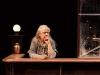
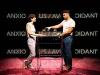
 The climb up seemingly endless flights of mercilessly graffitied stairs to suite 505 at 342 Elizabeth Street, Surry Hills, is a trip worth making. The Old 505 Theatre is remade from the skeleton of the original 505 jazz club, at first a secret, then not-quite-so-secret, illegal venue which has afforded opportunities for Sydney's jazz community to ply its trade that little bit more often. The Old 505 curates a varied programme incorporating both new and established artists. The Twelfth Dawn falls into the latter, being a work devised by Gareth Boylan, Kerri Glasscock and Michael Pigott. Apparently, like that child who's much younger than his siblings, it was an accident, stumbled into while preparing to start work on something else entirely. Its inspiration was David Malouf's novel Ransom, itself a retelling of that final chapter of The Iliad in which the defeated Trojan King Priam recovers the body of his son, Hector, from the Greek victor, Achilles. In workshopping it, the co-devisors wended their way back to the source. Having said all this, without prior knowledge of this genesis, you'll be doing well to pick up any of these references, since this talented trio has shot off on a tangent, exploring more broadly the sometimes blurry lines between fact and fiction, myth and mundanity, sleep and wakefulness. Wittingly or unwittingly, I think they do something else besides: they delve into the very nature of the creative mind, fuelled by what Arthur Koestler coined bisociative thinking; that thinking that transcends mere associative thinking, connecting previously unconnected frames of reference. We might otherwise talk in terms of quantum leaps.
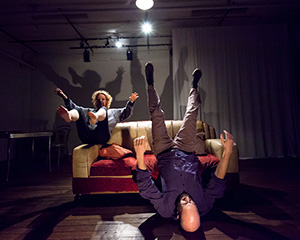
Certainly, this is work which leaps off the stage with a strange, visceral magnetism. From the fragments of the ancient is born something utterly contemporary. Text tends to be overwhelmed by nightmarish imagery and, even moreso, physical theatre, mostly executed by the intimate interplay between Glasscock and Pigott. It's carefully choreographed, robust yet tender, almost operatic insofar as the depths of emotion plumbed. Much of it takes place on a humble couch, a suburban artefact set alight with the jumble, rumble and tumble of bidden and unbidden feelings that enter and complicate all relationships; the confounding cacophony of love-hate that insinuates itself into dark recesses, hidden pockets and crevices, as if to prove, once and for all, L'amour est un oiseau rebelle. Of course, there are situations wherein these dynamics are heightened, such as when a couple loses a child; something that's alluded to here. This revelation, however, comes very late and the intrigue aroused as to its nature is unflaggingly sustained; we feel its enormity and can clearly see its impacts. We derive an unmistakable sense that though normality has prevailed, these people, by turns estranged, cold and distant, then clinging to each other like puppies stripped of their mother, have embarked on a slow, inexorable descent into a private hell.
Along the way, though, the piece meditates on the damaged and delusional states we can so easily enter into if deprived of the sanctuary of sleep and sweet, or not so sweet, dreams and this proves as compelling as the narrative climax. The ordinary can suddenly become the extraordinary, in the worst possible way as, from a personal perspective, everything changes shape. As scary as it may be, it's also presents a rare opportunity to traverse very unfamiliar territory, as remote as the moon; paths by which one can turn on, tune in and drop out, without the need for chemicals outside one's own body.
The Twelfth Dawn inhabits the uncomfortably familiar space between the uninhibited imaginativeness of the unconscious, which can take us on journeys both magical and dangerous, and the rationality of the conscious. It reflects on our need to create our own myths and realities, in order to cope and survive. It finds the drama in domesticity; the pathos in parenthood; the gouging pain in grief. A clever storytelling conceit is to have Boylan stand outside the tale, to an extent, as a kind of narrator, or observer, like us. It suffices as connective tissue, drawing us more readily into an empathic posture.
While Boylan is a talented director, he doesn't seem quite as confident or surefooted as a performer and nerves, on opening night, tended to get the better of him; much as he warmed to the role as the play wore on. Glasscock and Pigott, however, again prove themselves to be outstanding, not only on their own behalfs, but one-on-one: there's a rapport between them no amount of rehearsal can build-in. The simple set and well-managed sound design were also impressive, especially given the limitations of the space and budget. This is a play that, while far from flawless, exudes the kind of energy and mystery that seem to be hardwired, as it were, into the human genome. What will they think of next? I look forward to finding out.
The Old 505 Theatre presents
The Twelfth Dawn
Devised by Gareth Boylan, Kerri Glasscock and Michael Pigott
Venue: Suite 505, 342 Elizabeth St Surry Hills NSW
Dates: 3 – 28 July, 2013
Times: Wed – Sat 8pm, Sun 7pm
Tickets: $25 – $15
Bookings: trybooking.com